Friday, May 18, 2018

C'est Fini!

It's over!
I probably write that at about this same time every year when the water level of the Peace River gets too high for digging.  
Luckily we worked in a final 3 day camping trip before the rains started, and dug our little hearts out.
I brought along a kayaking friend, Kitty, and although she is no stranger to hunting for fossils, nor kayak camping, the whole digging in the river deal was new to her.  
She did a lot of digging but also took advantage of the peace and quiet of the area.

She looks like she's reading but she's not.
She's asleep.
But before the nap, she managed to find this really cool fish jaw:


Before I get into the fossils, here's one of my more interesting and unsettling finds:

A straight razor that is still incredibly sharp.  Yucky thoughts of accidentally stepping on this the wrong way.  The name "Cheminova" is imprinted on one side and all I could find on Google was an Indian agricultural chemical company which kind of makes sense for the area.
All that being said, watch your step out there!

And now for the fossils!
I found some more glyptodont scutes including a thick double section:

A nice pre-equus tooth (I think):

I found several equus teeth which made Kitty comment that a horse must have died in that spot.  
Pam and I tried to explain how to know when things were and weren't "associated".

Here's a handful of little goodies:

Some gator teeth:

Small bison tooth:

Interesting crystalized marine items including sea urchin spines, coral, and a shell:

Antler:

Turtle:

Broken fish mouth plate, barracuda tooth, and twig/root:
(I know I'm scraping the bottom of the barrel here but I told you I didn't have a great season)

Mammoth and mastodon enamel:

And some shark teeth, always nice to find:

We made a new friend in camp:

and tried a new recipe that we will continue to perfect:
(That's butterscotch, chocolate, and marshmallow fluff on a banana)

Goodbye, dear camp!  I hope to see you again next year!

I wanted to throw in a photo of a new t-shirt I bought:


Here's some additional information from Wikipedia regarding the Bone Valley area of Florida which contains the Peace River.

The Bone Valley is a region of central Florida, encompassing portions of present-day Hardee, Hillsborough, Manatee, and Polk counties, in which phosphate is mined for use in the production of agricultural fertilizer. Florida currently contains the largest known deposits of phosphate in the United States.
Large walking draglines, operating twenty-four hours a day in surface mines, excavate raw pebble phosphate mixed with clay and sand (known as matrix). The matrix contains a number of chemical impurities, including naturally occurring uranium at concentrations of approximately 100 ppm. Because this phosphogypsum is slightly radioactive, its use is banned in most situations.[1]
The matrix is then dropped into a pit where it is mixed with water to create a slurry, which is then pumped through miles of large steel pipes to washing plants. These plants crush, sift, and separate the phosphate from the sand, clay, and other materials, and mix in more water to create a granular rock termed wetrock. The wetrock, which is typically of little use in raw form, is then moved largely by rail to fertilizer plants where it is processed. The final products include, but are not limited to, diammonium phosphate (DAP), monoammonium phosphate (MAP) and trisodium phosphate (TSP).
Waste byproducts are stored in large phosphogypsum stacks and settling ponds, often hundreds of acres in size, and up to 200 feet (60.96 m) tall.
Phosphate processing produces significant amounts of fluorine gas, which must be treated by filtering through special scrubbers.
Much of the final product (known within the industry as 'dryrock') is transported by rail to facilities along Tampa Bay, where they are transloaded onto ships destined for countries such as China.
Phosphate product intended for domestic use is assembled into Unit trains of covered hopper cars for northbound movement.
Phosphate is a declining export to China. Previously, significant amounts of rock were shipped to China, where it was processed into phosphate fertilizer. The majority of phosphate mining in Florida is done in the Peace River watershed. Phosphate mining companies use draglines to remove surface soils up to 60 feet (18.29 m) deep over thousands of contiguous acres. Once land is mined, state law requires that it be reclaimed. Wetlands are reclaimed on an acre for acre, type for type basis. Most modern mining permits actually require companies to recreate more wetlands than were initially present on the land. More than 180,000 acres (728 km2) have already been mined and reclaimed in the Peace River watershed. As reserves in the northern portion of the bone valley are depleting, mining companies are now seeking permits for another 100,000 acres (405 km2), which will replace reclaimed mines to the north.
One byproduct of the extraction process is clay, which is stored in settling ponds and eventually comprises 30%-40% of a mine site. Some of these ponds can measure thousands of acres. Rain drains slower through these clay-laden ponds than typical soil. Critics argue that this, in turn, reduces baseflow to the Peace River. Some studies have indicated that reclaimed lands actually provide a more consistent baseflow because the sandier soils of the reclaimed land provide faster baseflow, while the clay provides a slower steady flow, creating more flow during dry periods than native land. Since the 1960s, the average annual flow of the middle Peace River has declined from 1,350 cubic feet (38.23 m3) to 800 cubic feet (22.65 m3) per second (38.23 to 22.65 m³/s). Critics argue that this flow reduction is due to phosphate mining, but studies by the Southwest Florida Water Management District have shown that the reduction in flow is due to multidecadal oscillation in Atlantic Ocean temperatures.
Critics argue that each holding pond has been perceived as a risk that threatens water quality, public health, wildlife, and the regional economy. Dams restraining the ponds have overflowed or burst, sending a slurry of clay into the river, and coating the riverbed for many miles with a toxic clay slime that suffocates flora and fauna. One such incident in 1971 killed over three million fish when 2 million US gallons (7,600 m3) of phosphate waste swept into the river, causing an estimated 5-foot-tall (1.5 m) tide of slime that spread into adjacent pastures and wetlands. Since the 1971 spill, clay settling areas are now constructed as engineered dams. No such spills have occurred from any settling areas built to these standards. The current dams withstood three hurricanes which crossed the Bone Valley in 2004.
In 2004, during Hurricane Frances, a phosphogypsum stack was overwhelmed by hurricane rains and the levees were breached, sending over 18,000 US gal (68,137 L) of acidic process water into Tampa Bay. Cargill Crop Nutrition, who owned the stack, added lime into the affected areas in an attempt to neutralize the highly-acidic runoff. Due to the extraordinary amount of runoff created by the hurricane, the spill was quickly diluted and environmental damage was minimal. In a consent agreement with the Department of Environmental Protection, Cargill greatly increased its water treatment capacity at the facility. The facility is a no discharge facility and was overwhelmed by the above normal rainfall in 2004, in addition to being affected by three hurricanes.
On occasion, clay slime spills have prevented the Peace River Manasota Water Supply Authority from using river flows for drinking water, forcing municipalities to seek water supplies elsewhere, or rely on stored supplies. On several occasions, the effects of heavy rainfall have created sinkholes beneath the settling ponds.
Most recently, in August 2016, a sinkhole opened up under a gypsum stack at the Mosaic’s New Wales fertilizer plant in Mulberry, Florida. 215 million gallons of containment water dumped into the Florida Aquifer.[3]


Monday, April 30, 2018

Checking Out New Neighborhoods

Nobody's going to tell me where to fossil hunt
on the Peace River.
Those newbie days are gone and to be fair, I'm rather withholding when it comes to divulging good digging spots as well.  
The prospecting continues.
I said I wasn't going to look at FaceBook anymore but of course, I did.
I saw a post that said, "Yesterday the river was handing out megs like candy."
Candy is one of my favorite things...
but apparently I am on the river's sh*t list.

I spent a day poking around last week
but my heart wasn't in it and several times I considered just heading home, but
fossils only come to those who dig,
so I stopped in a shallow area and started digging.
For a day that was almost a wash, I managed to find a couple of cool things.

Maybe the biggest tiger shark tooth I've found:

A super sweet little mako:

Giant armadillo scute:

Pristine shark teeth:

Two interesting shark teeth:
 

Assorted fish and shotgun shell parts:

Turtle and tortoise:

This and that:

And, of course, old whiskey bottles:
There's never an end to the alcohol related detritus on the Peace River.
Next weekend, camping!

Here's some reading info regarding collecting old whiskey or "whisky" bottles from Collectors Weekly.  Maybe if I dig deeper, I'll find the good ones.

Strictly speaking, there’s no such thing as a "whiskey" bottle in Scotland. There you will find only "whisky" bottles, hopefully filled with a single-malt Scotch by Speyside distillers such as Macallan, Balvenie, or Glenfiddich. For some, collecting such rare whisky bottles is its own reward; for others, the virtues of these bottles are best appreciated by savoring their contents. In Ireland and the United States, the word "whiskey" generally gets an “e,” while in the U.S. the term itself most commonly refers to Bourbon and rye. Bourbon is made from about 70% corn and is aged in oak barrels. Most of the biggest distillers, from Jim Beam to Maker’s Mark, are in Kentucky. Tennessee is also a center for whiskey, although its best-selling export is not labeled as Bourbon; Jack Daniel’s makes Tennessee whiskey. As for the bottles themselves, some of the earliest ones produced in the U.S. date from the beginning of the 19th century and have squat, cylindrical shapes. Less symmetrical were the so-called chestnut flasks, whose bulbous bodies tapered abruptly to a slender neck. Numerous other types of spirits bottles were produced throughout the 19th century and into the 20th (Jack Daniel’s went to its famous square bottle in 1895), but serious bottle collectors look for the figured flasks made from about 1815 until 1870. These flat-sided bottles, which were often pear-shaped or oval, featured relief portraits of U.S. presidents and patriotic symbols such as eagles on their sides. Other celebrities immortalized on antique whiskey bottles included the French General Lafayette (a hero of the revolutionary War), Jenny Lind (a famous singer of the day, who was known as the Swedish Nightingale), and DeWitt Clinton (as governor of New York, he presided over the construction of the Erie Canal).

Sunday, April 22, 2018

West Virginia Attitude Adjustment

I knew I just needed to get away from that dang river
and I'd get my head on straight.
I am so grateful to have access (through my friend) to a place where I know I'll find arrowheads.  How many people can say that?
This was my 5th annual visit
and I got to borrow some groovy rubber boots for slogging through muddy fields.
It was mesmerizing to glimpse my Austin-Power-styled feet as I scanned the ground for arrowheads.
The boots brought me luck (or at least dry comfort) because I had a very productive visit.
I'm also gaining experience in spotting tiny worked edges
 and points that are hiding out under dirt clods.
The above point is one of the best I've found on my visits.
It's better after a rain because the darker points contrast better with the soil.
I went a month earlier this year which made a big difference in the temperature.  The days were beautiful but at times there was a freezing wind that required additional protection for my schnoz.
I used an app to map our path and found that we were walking about 5 miles a day through rough fields.  That explains why something so slow and calm is so exhausting!
We might be in hillbilly country but we travel with homemade quinoa tabouleh and local IPA's.
I have my limits when roughing it.
The last point I found was so exciting:
Even a missing corner can't dim my enthusiasm for this beauty.
Here's my haul for 2018.
But did you think I wasn't going to look for fossils?
Wrong!
I went back to my little hillside for some Devonian brachiopod love (legal in West Virginia).  
See them piling up behind me?  
Right under the local IPA.
I've decided, at the age of 53, that I need to document my handstands because I never know when it will be the last.  Here's my first West Virginia handstand.  I was cold, tired, and buzzed, 
but it was a passable attempt.
I love this spot because the matrix is incredibly soft.  It doesn't split in nice plains but the hammering is so easy, I won't complain.
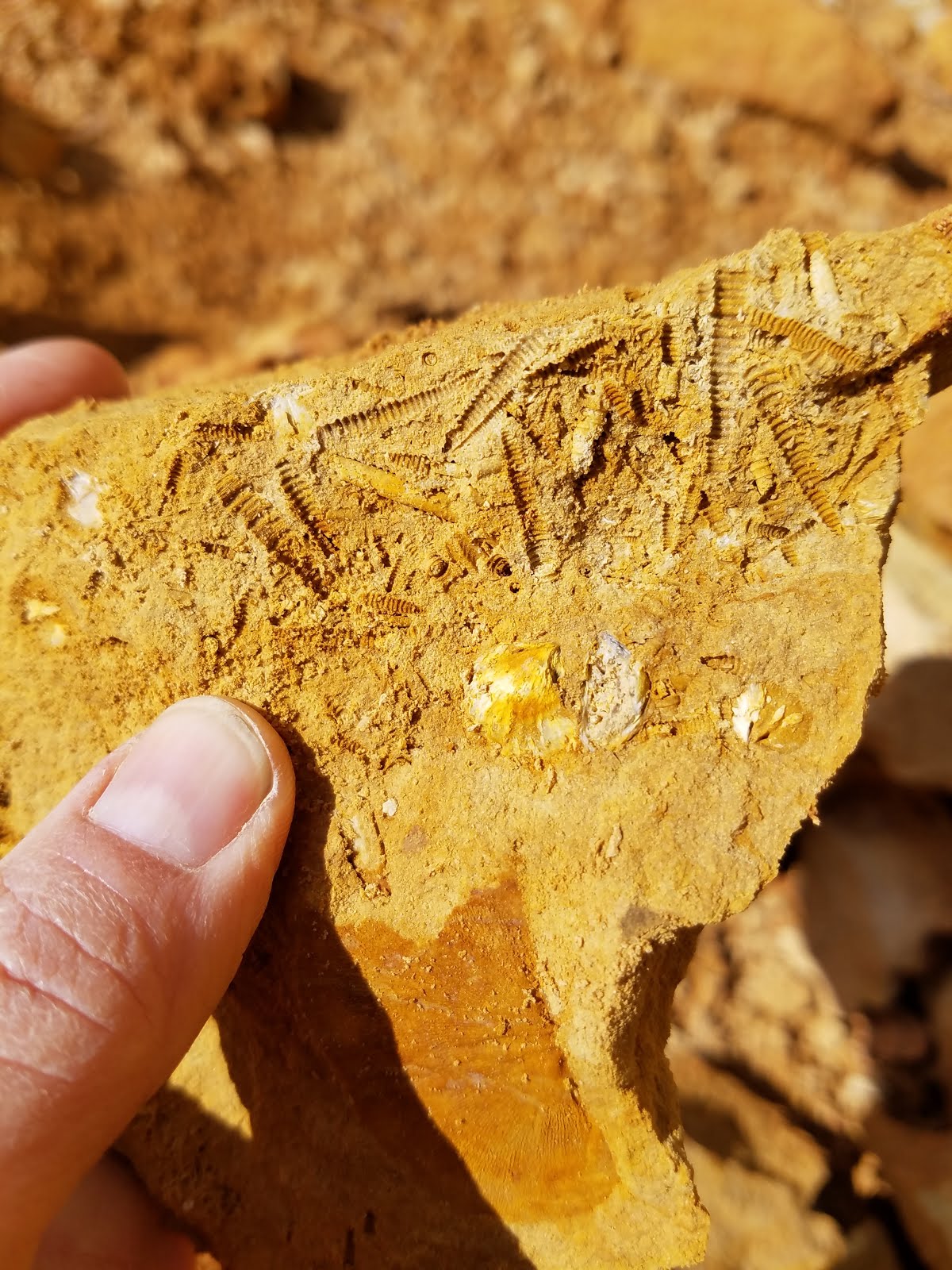
Lots of tentaculite impressions and even some fossil remains.  
I didn't get any trilobite love this time.  
Just one impression.  
I know they're in there! Maybe next year.
A nice collection for no more than 2 hours on the hill
 and I really only worked one small section of rock.
This photo is called,
"Get ready, TSA! Here I come!"
I find it smooths the way if I announce from the get go that I have a suitcase full of rocks.
The Charlottesville, Virginia airport is very small so it's not much of a hassle to unpack and repack everything for the hand check.  In fact, I was the only person to be seen at security.  
The West Virginia trip cleared my mind and got me ready to head back to the river.
I'm not saying I won't keep bitching and moaning if I don't find stuff, though.

For your further reading pleasure...

I was snuggled under a quilt in West Virginia and noticed this fabric tag sewn to the underside.
I grabbed my phone and looked up all the info, discovering that I was sleeping under a quilt probably made in the 1800's.  I immediately considered carefully folding it up and looking for a modern, machine washable blanket but these treasures were always meant to be used, a practical use for leftover fabric scraps in the time before WalMart and disposable clothing, bringing beauty to the home and comfort to its inhabitants.  
Here's the intro on the West Virginia Heritage Quilt Search site.  Check it out for a look into our nation's past.

<<Tucked away in the Appalachian Mountains of West Virginia, preserved for generations, handmade bed quilts are windows into the past. In 1983, three West Virginia county extension agents discussed the need to locate and document their state's historic quilts. In 1992, West Virginia Heritage Quilt Search held documentation days throughout the state to collect and preserve the valuable information stitched into these quilts.

The search focused on documenting quilts made in West Virginia before 1940, which marked the end of a fertile period in American quilt history and the beginning of a decline in quiltmaking that would continue until the 1970s. Ultimately, the search registered more than 4,000 quilts.
This effort has culminated in West Virginia Quilts and Quiltmakers: Echoes from the Hills, published by Ohio University Press on November 1, 2000, in association with the West Virginia Heritage Quilt Search, Inc. The book includes 159 color photographs of selected quilts, with maps showing where they were made, a database analysis of the statewide survey, and the oral histories of descendants of quiltmakers.>>


Friday, April 6, 2018

The Heartbreak of FaceBook

I can't look at FaceBook fossil pages right now.
In a fossil season where I'm finding next to nothing,
it's painful to see people pulling in hand size megs and whole mammoth teeth.
The humanity!!!
I believe because I struggle with feelings of competitiveness and jealousy that I am even more sensitive right now to people who post fake "in situ" videos and photos.  I know they really found the items they post but just label it as a reenactment so I don't have to sit at home
 venting to my dachshunds. 
Me and my damned eye for detail!
Sigh...

So my last trip to the Peace was, comme toujours,
DISAPPOINTING.
The saving grace was a reality check by a group that passed us in canoes and about lost their sh*t when they saw a single little shark tooth we had found.  
It's all about perspective.


In the spirit of being thankful for the little things in life,
I found these 2 excellent pre-equus horse teeth.

And this was my first cetacean ear bone of this size.  
I usually just come across the small dolphin-sized ones. 

I was wondering if this was a coprolite:
It's fragile, though, and broke and just looks like mud inside, 
but I would imagine alligators end up eating mud on occasion. 

I found a couple of fossilized fish mouth plates
 and dug out some modern fish mouth plates for comparison.  

A fossilized deer tooth from that day compared to modern deer teeth that I just found in a field.


I have modern sand dollars to compare this too, as well, but you get the idea.

A fish nose plate.
(Oh, it's gettin' thin up in here!)

And a small vertebra that isn't even fully fossilized.
That's it.
If I'd written this on paper you would be able to see the tear stains smearing the ink.
Nothing to do but keep digging, and so I shall.
But first, my annual trip to West Virginia approaches.
I'm going a month early this year due to some scheduling issues and may end up looking for arrowheads and fossils in a landscape like this:
Noooo!!!!!
Fingers crossed they get a warm up soon.

I was looking for extra info to add at the end of this post
and started looking at sites about fish mouth plates.  I was a little freaked out to discover that if you keep puffer fish in an aquarium you will periodically need to trim their teeth.
Whaaat?!!!
That right there would be enough to convince me to never keep a puffer fish.  I tried to watch a YouTube video of someone trimming a puffer fish's teeth but I couldn't do it.  You would've thought I was trying to watch live surgery.  Anyway, check it out from the wetwebmedia web site of fish dentistry and other things you never want to do.

Is your puffer becoming a little long in the tooth? Is it starting to resemble Bucky the Beaver? Then it is time to trim your puffer's teeth!
Puffer's Diet
All puffers need hard-shelled, meaty foods to keep their teeth trimmed. Like rabbits, their teeth grow constantly and can overgrow enough to cause starvation in the fish. Puffers eat crustaceans in the wild. Foods for smaller puffers are frozen/freeze-dried krill/plankton, gut-loaded ghost shrimp, glass worms, crickets, worms and small snails (the size of their eye). Snails are an essential food to a puffer's diet, especially when small. Many serious puffer keepers breed their own snails. The easiest way to start your snail "nursery" is to gather them from live plants at your local fish store. Most folks won't mind your taking them, since they are considered pests. Do not feed your puffers the ice cream coned shaped snails called Malaysian trumpet snails! MTS's shells are too hard for puffer's teeth and have been known to crack them, making it difficult for them eat correctly.
For larger puffers, there are many more crunchy foods to eat. Large puffers will eat scallops, shrimp, crab legs, mussels, clams, oysters, squid, lobster and crayfish. Mine love to chase live crayfish, fiddler crabs and gut-loaded ghost shrimp. I gut-load (pre-feed) my live food with algae wafers, so my puffers get their veggies. You should be able to buy most of these foods at the fish department of your grocery or produce store, freeze and later thaw in warm vitamin water as needed.
Improper Diet
Lack of the proper diet will result in overgrown teeth. Once they are long, they will not be able to open their mouth's to eat and will starve to death. Sometimes the puffers will try to eat but just spit back their food. At that point, no amount of crunchy foods can help and the puffer's teeth must be trimmed by hand. Two species of freshwater puffers that need a constant daily supply of snails are the South American puffer (Colomesus asellus) and the less common bronze or golden puffer (Auriglobus modestus). Without enough snails offered to them, they would need their teeth trimmed every 4-6 months. I have both species and do trim their teeth often.
For puffers under 4", fill two, one-quart containers with 3 cups of tank water. Put 3 drops of clove oil in 1 container.
Add the fish. Within 1 minute the fish will roll on it's side and then lay on its back. It will seem dead. This will look scary to you, but your fish will be fine.
Take the fish out with a net, (as to not harm it's skin with the oils of your hand) & hold it through the net. Peel back the net, until the puffer's head and teeth are exposed. Quickly but carefully clip its teeth with cuticle nippers, being sure not to cut its mouth. Their teeth are different than you'd think. It's more like clipping a fingernail. Try clipping straight across and as short as feasible. Make sure to pull down the lower lip and check those teeth too.
Place the puffer in the container of fresh tank water. You should see it breathing. After 1 minute it will right itself, and within 2 minutes it will be swimming around. After your puffer seems calm and is swimming normally around the container, you may place it back in the tank. Keep an eye on it for a while; it should be swimming as if nothing has happened.
This all needs to be done as quickly as possible, as clove oil can also be used for painless euthanasia of fish. The first time I attempted this procedure, I didn't use clove oil. The fish squirmed so much I cut the poor things upper lip off and it never grew back. Also, once the fish is tranquilized, you may remove it out of the water, without the worry of it puffing with air. A puffer puffing with air can become a deadly proposition, if the air can't be removed. I do not recommend tranquilizing your fish if it is sickly or has been weakened due to starvation--it may not recover!
Please note, puffers needing dentistry, have been as small as ¾" and as large as 2-3". This process can also be used on larger puffers. You will need a much larger container and a Dremel tool for trimming. I also suggest a 2nd pair of hands for handling the big guys.
Good luck, stay calm and happy trimming!